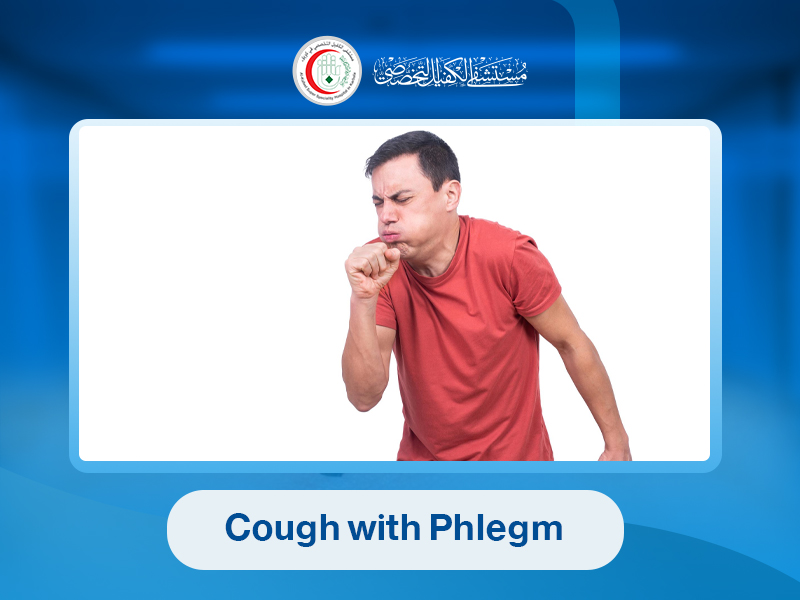
A cough is the body's method of removing and expelling foreign bodies or mucus from the lungs and airways.
How a cough occurs
Sensory receptors located in the respiratory tract send a stimulus to the brainstem when sensing the presence of a foreign body or an inflammation. This leads to a reflex that activates the respiratory muscles and the diaphragm in a coordinated manner to rapidly and forcefully move air into the respiratory tract in response to the stimulus sent by the receptors.
A cough is defined as a cough accompanied by phlegm when there are secretions expelled during coughing. These secretions are generally mucus produced in the airways to protect and clean them from pollutants and small foreign bodies.
As is known, a productive cough, meaning a cough accompanied by various secretions, may contain different substances, such as: blood, mucus, or pus. The color of these secretions can be green, yellow, white, pink, or dark red.
Symptoms of a Cough with Phlegm
A cough in itself is a symptom, not a disease. Usually, the true nature of a cough and its causes only become apparent after the appearance of other symptoms, or after conducting accurate physical and imaging examinations.
Causes and Risk Factors of a Cough with Phlegm
As mentioned, a cough with phlegm is accompanied by the secretion of salivary substances called phlegm or mucus. The source of this saliva is either the lungs, i.e., in the bronchioles located inside or outside the lungs, or from a higher source, such as: the nose or sinuses. In this case, the saliva moves to the airways due to the effect of gravity via the back of the throat.
The most prominent causes of a cough with phlegm include the following:
1. Viral Disease
It is very common for a cough with phlegm to accompany viral diseases, such as: the common cold or the flu. In this case, the cough usually occurs due to mucus draining from an upper source via the back of the throat.
2. Catching an Infection
An infection of the lungs or the respiratory tract connected to the lungs can lead to a cough with phlegm. The diseases we are talking about in such a case include:
• Pneumonia.
• Bronchitis.
• Sinusitis.
• Tuberculosis.
3. Chronic Lung Diseases
A cough with phlegm usually accompanies serious chronic lung diseases, such as: Chronic Obstructive Pulmonary Disease (COPD), where a cough accompanied by phlegm is one of the symptoms of the exacerbation of the disease that has affected the respiratory tract.
4. Gastroesophageal Reflux Disease (GERD)
Stomach acids refluxing through the upper esophageal sphincter can cause a cough, and this cough often occurs during the night due to gravity.
5. Mucus Drainage via the Back of the Throat
This is what causes the urge to clear or scratch the throat, and this is one of the common and widespread cases.
6. Smoking
The damage inflicted on the respiratory tract and lungs by smoking causes a chronic, mucus-filled cough.
Complications of a Cough with Phlegm
The most common complications of having a cough include:
• Pain in the chest and abdomen.
• Inability to control urine, and urinary incontinence during coughing.
• Fatigue.
• Fainting and temporary loss of consciousness, due to decreased venous return of blood to the heart resulting from elevated positive pressure in the chest.
• Rib fractures, even in healthy individuals, due to coughing.
Diagnosis of a Cough with Phlegm
A cough is a pathological symptom in itself and not a disease, and the doctor must conduct a comprehensive physical examination to identify other symptoms that could help us diagnose the causes of the cough. The examinations that could help us diagnose and determine the causes of a cough in such cases are:
1. Blood Oxygen Saturation Test
This is done using an electrical measuring device placed on one of the fingers.
2. Lung Function and Maximum Expiratory Capacity Test
Or what is called spirometry, which helps in the diagnostic process for some medical conditions like asthma or various lung diseases.
3. Imaging Tests
Which can help diagnose and determine the causes of a cough, namely chest X-ray imaging, as this test is conducted when there are indications of disease infection during the physical examination and auscultation of the lungs. A computed tomography (CT) scan of the sinuses in the skull may also be performed to verify their infection.
4. Throat Swab
To detect pertussis (whooping cough) bacteria.
5. Other Tests
To detect a cough from an upper source, a post-nasal drip test is performed, as well as a lung function test, and even an esophageal acidity test to detect gastroesophageal reflux.
Treatment of a Cough with Phlegm
Treatments vary according to the nature of the cough as follows:
1. Treatment of an Acute Cough
The disease causing the cough, the cough reflex, and various factors that increase the severity of the cough must be treated, through:
• Antiviral drugs: To treat viral infections, which are rarely given.
• Antibiotics: To treat bacterial infections.
• Beta-agonist medication: A patient suffering from bronchitis can be given this medication to alleviate the severity of the cough.
• Post-nasal drip treatment: Using antihistamine drugs, steroids, or blood vessel decongestants.
• Gastroesophageal reflux treatment: Done with drugs that reduce stomach acid production.
2. Treatment of the Cough Reflex
This is done by taking drugs that affect the brainstem and raise the minimum threshold required to stimulate a cough, and of course, this is done after consulting a doctor.
3. Chronic Cough
Treatment is carried out as follows:
• Pertussis treatment: Using antibiotics to reduce the infection.
• Treatment of a chronic cough with no known source: By inhaling a local anesthetic and Morphine Sulfate.
Prevention of a Cough with Phlegm
The prevention process for a cough revolves around attempting to prevent its causes, and the most important of these methods are:
• Maintaining personal hygiene during the winter to reduce the chances of catching viral and bacterial diseases.
• Abstaining from smoking, whether direct or passive smoking.
• Protection from environmental pollutants.
• Maintaining a healthy diet to strengthen the immune system.
Alternative Treatments
It should be noted that Echinacea and Vitamin C are not considered effective treatments if used after the appearance of a cough.
Follow these steps to help treat a cough with home methods:
Thyme
Thyme helps in treating a cough and infections of the upper respiratory tract and bronchi, as it contains compounds that suppress coughing, and it helps relax throat muscles and reduce inflammation and headaches. To prepare a thyme drink, do the following:
• Mix two teaspoons of ground thyme with a cup of hot water.
• Cover it for 10 minutes.
Flax, Honey, and Lemon
Boiling flaxseeds and consuming them will help soothe the bronchi and reduce coughing. You can add honey and lemon due to their anti-inflammatory properties. Perform the following steps:
• Boil two to three tablespoons of flaxseeds in a cup of water.
• Add three tablespoons of honey and fresh lemon juice.
Lemon
Lemon has great properties that help you get rid of the annoying cough you suffer from, so put some black pepper and salt on a lemon and eat it.
Milk
It is considered one of the home remedies that help you treat a cough, so mix some honey with milk before consuming it.



-
Celebration of Imam Ali’s Birth Anniversary
Medical Units for Arbaeen Pilgrimage
Celebration of the Prophet Muhammad's (PBUH) Birth Anniversary
Celebration of Lady Zainab's (peace be upon her) Birth Anniversary
Bringing Joy to Patients on the Occasion of Imam Ali’s (peace be upon him) Birth Anniversary
Alkafeel Hospital Celebrates the Birth Anniversary of Imam Hussein (peace be upon him)
Joy Fills Alkafeel Hospital on the Birth Anniversary of Abu Al-Fadl Al-Abbas (peace be upon him)
Al-Kafeel Hospital participates in Arbaeen pilgrimage
-
Job Fair Participation at Al-Kafeel University
First Al-Kafeel Symposium on Musculoskeletal and Spine Surgery
IT Forum in Dhi Qar
University of Al-Kafeel Scientific Conference
Baghdad International Fair
Alkafeel Hospital Participates in the Sixth International Medical Sciences Conference at Al-Kafeel University
Alkafeel Hospital Participates in Iraq’s First Medical Tourism Conference, Affirming Its Pioneering Role in Health Sector Development
-
Training Lecture on Hospital Hospitality Services
Civil Defense Training Program
Training Program for Sama Karbala Foundation Staff
Workshop for Administrative Development Academy Trainees
Training for Turkish Hospital Medical Staff
Cervical Cancer screening Workshop
Scientific workshop for anesthesia students
Nursing Workshop for Dhi-Qar Province
Workshop on Quality and International Accreditation Standards
Hand Hygiene Training Workshop
Laboratory Training for Sama Karbala Foundation Staff
Wound Care Training for University Students
Scientific Workshop on General Surgery
Scientific Lecture on European Society of Cardiology Guidelines
Surgical Suturing Workshop for Medical Students
Accounting System Workshop for Administrative Development Academy Students
Risk Management Training
Training on Electrocardiography and Cardiac Arrhythmia Management
Proper Handwashing Techniques Workshop
Educational Lecture on Benign Prostatic Hyperplasia
Interactive Lecture for Medical Students of Al-Ameed University
Training on Cardiopulmonary Resuscitation for Dental Students
Security Staff Training on Explosives Detection Device “ID”
Delegation of Biomedical Engineering Students from Al-Safwa University
Human Resources Workshop for Hospital Departments
Radiation Protection Training Course
Quality of Medical Services Presentation
Fire Safety Training Workshop
Scientific Workshop on "Patient Safety"
Research Development Initiatives
Medical Training Workshop for University Students
Accounting Department Workshop
First Aid Training Workshop
Awareness Lecture on Early Breast Cancer Detection for Al-Siddiqa Al-Tahira Center
Training Program for Karbala Health Directorate Staff
Crisis Management and Fire Safety Training for Staff
Emergency Nursing Response Workshop
Students of the Administrative Development Academy Meet to Discuss the "Healthy Hospital" Project at Alkafeel Hospital
Successful Workshop on Workplace Etiquette Held at Alkafeel Hospital
Alkafeel Hospital Enhances Patient Satisfaction Through Specialized Training Course
Alkafeel Hospital Organizes Training Workshop to Enhance Anesthesiologists' Competency
Successful Breast Cancer Awareness Lecture at Alkafeel Hospital
Successful Workshop on PET Scan Technology Held at Alkafeel Hospital
Alkafeel Hospital Enhances Pharmacy Students’ Practical Skills
Alkafeel Hospital Emphasizes the Importance of Early Detection of Breast Cancer
Director of Alkafeel Hospital Discusses Development Strategies with General Surgery Team
Alkafeel Hospital Administration Strengthens Collaboration with Neurosurgery Team
Parliamentary Committee Commends Services at Alkafeel Hospital
Successful Workshop on Safety Practices Concludes at Alkafeel Hospital
Alkafeel Hospital Hosts Specialized Workshop on “Rezūm” Technology for Treating Benign Prostatic Hyperplasia
Alkafeel Hospital Enhances Efficiency of Its Human Resources Department
Organizational Meeting to Clarify the 2025 Postgraduate Application Process
Al-Kafeel Hospital Trains Its Staff on Safety and Evacuation Procedures
Sheikh Salah Al-Karbalai Delivers Religious Lecture to Alkafeel Staff
Alkafeel Training Center Concludes a Successful Scientific Day in Dentistry
Civil Defense Training at Alkafeel Hospital
English Debate at the Nursing Department
Meeting between Al-Kafeel Hospital and Al-Zaki Hospital in Babylon
Al-Kafeel Hospital participates in a workshop on Mass-Care Nursing
-
Spinal Surgery Patient Referrals
Spanish University Delegation Visit
Visit by Iraqi Ministry of Interior Delegation
Collaboration with Anwar Sheikha Hospital
Visit by College of Medicine, University of Diyala
Visit by Iraqi Ministry of Health Delegation
Shiraz University Delegation Visit
Visit by Faculty of Science – University of Karbala
Treatment of Pediatric Cardiac Patients
Memorandum of Understanding with Aster Medical Group
Delegation from Shahid Rajaei Hospital, Iran
Dr. Jassim Al-Ibrahimi Meets with Ministry of Health Referral Committee
Delegation of Medical Devices Students from Al-Mustaqbal University
Delegation of Medical Physics Students from University of Karbala
Student Delegation from Warith University
Meeting Between Dr. Jassim Al-Ibrahimi (CEO) and Department Heads
Visit by Croatian Academic Delegation
Meeting Between Al-Kafeel and Al-Battat Hospitals
Visit by Ministry of Health Delegation
Admission of Spinal Surgery Patients
Pediatric Cardiac Surgery Referrals
Meeting with Medical Students – Al-Ameed University
Collaboration with Karbala Nursing Syndicate
Visit by Al-Nahrain University Students
Dr. Jassim Al-Ibrahimi (CEO) Meets Top English Language Graduates
Visit by Al-Mustaqbal University Students
Alkafeel Hospital Holds Meeting with Dr. Moataz, Specialist in Internal Medicine
Alkafeel Hospital and Ministry of Water Resources Collaborate to Promote Public Health
High-Level Georgian Delegation Visits Alkafeel Hospital
French Delegation Visits Alkafeel Hospital: Toward Advanced Medical Collaboration
"A Leading Partnership to Support the Future of Engineers": Alkafeel Hospital Signs Cooperation Agreement with the College of Engineering at the University of Karbala
Alkafeel Hospital Provides Medical Care to the Blind Football Federation Players
High-Level Swiss Delegation Visits Alkafeel Hospital
Al-Nahrain University and Alkafeel Hospital Discuss Prospects for Joint Cooperation
President of the University of Babylon Explores Alkafeel Hospital’s Services and Discusses Future Cooperation
Alkafeel Hospital Commends the Civil Defense Directorate for Their Support
High-Level Georgian Delegation Visits Alkafeel Hospital
Academic Collaboration Between the University of Karbala and Alkafeel Hospital
Prospective Academic Cooperation Between the University of Karbala and Alkafeel Hospital
Ministry of Health Delegation Praises Dental Center at Alkafeel Hospital
Ongoing Collaboration Between Alkafeel Hospital and the Ministry of Health in Corneal Transplantation
Alkafeel Hospital Receives a New Group of Spinal Deformity Patients
Academic Delegation Praises Alkafeel Hospital
Expanding Health Insurance Coverage: Discussions Between the Al-Abbas Shrine and the Ministry of Health
Delegation from the Imamia Medics International Visits Alkafeel Hospital
Productive Academic Collaboration Between Al-Kafeel Hospital and the University of Babylon
College of Tourism at Al-Mustansiriya University: Al-Kafeel Hospital Sets a Distinguished Standard in Hospitality Services
Al-Kafeel Hospital Hosts Medical Delegation from Al-Muthanna Hospital
Citizens: Alkafeel is a Pioneer in Pediatric Cardiac Surgery and an Alternative to Medical Travel Abroad
Alkafeel Hospital Opens New Avenues of Collaboration with Maysan Health Directorate
Algerian Delegation Explores Alkafeel Hospital’s Advanced Medical Technologies
Qatari Delegation Visits Alkafeel Hospital to Discuss Joint Collaboration
Alkafeel Hospital Launches a Successful Vision Care Initiative in Maysan
Signing of a Cooperation Agreement between Alkafeel Hospital and the University of Karbala
Visit of Al-Ameed University Students to Alkafeel Hospital
Eye Examinations and Treatment for Students from Maysan Schools at Alkafeel Hospital
Visit of the Health Insurance Authority Delegation to Alkafeel Hospital
Alkafeel Hospital and Marina Al-Ahly Hospital Sign Memorandum of Understanding
Visit of Dr. Jassim Al-Ebrahimi to Marina Surgical Hospital
Al-Kafeel Hospital prepares for the Health Insurance Program
Link copied