


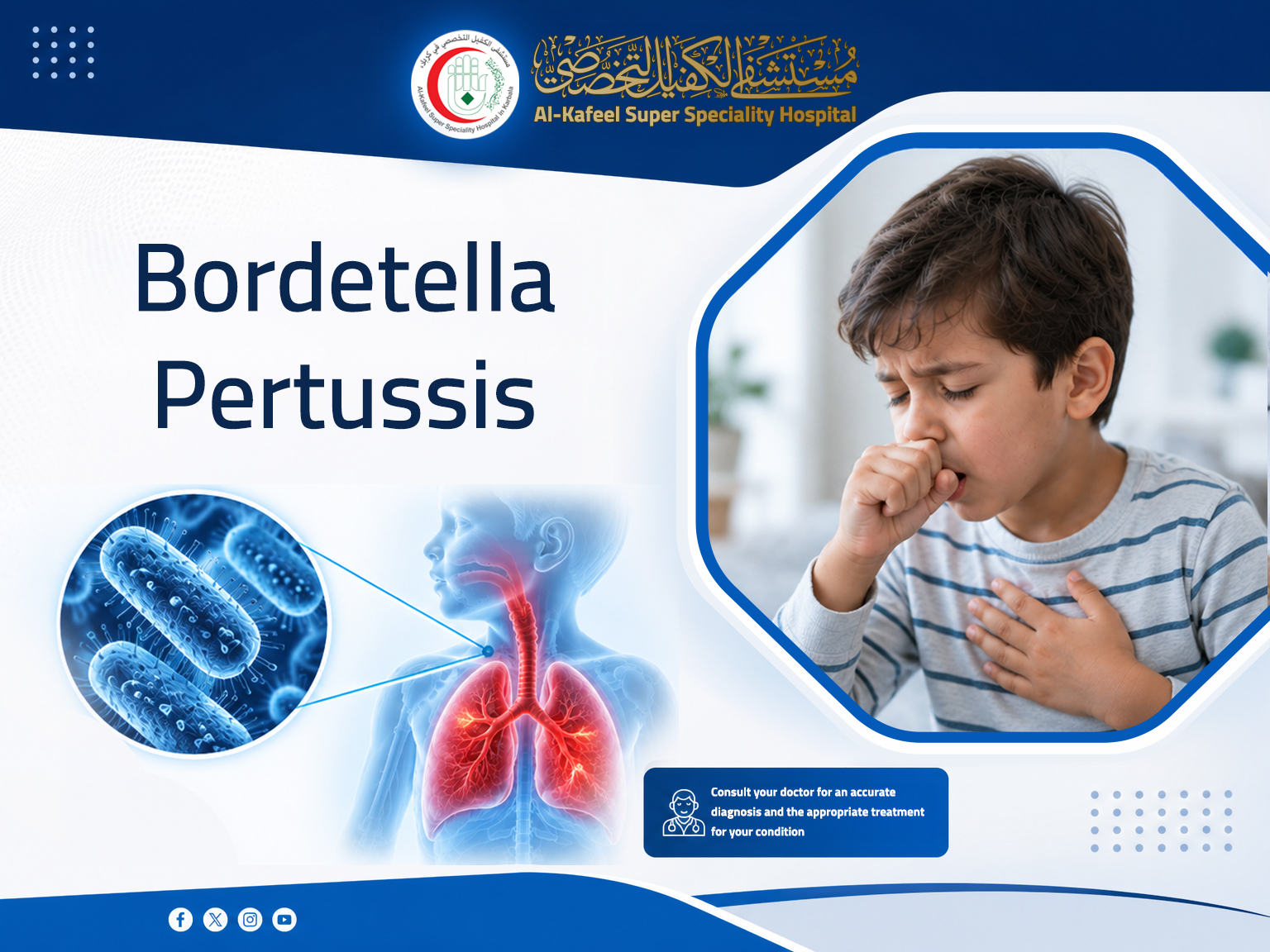
Bordetella pertussis is an aerobic, Gram-negative bacterium known as the main cause of whooping cough (pertussis), and it is characterized by its whip-like shape.
The Bordetella pertussis bacteria spread from the infected person into the open air while coughing, and in this way, they can be transmitted from one person to another. The incubation period of the disease they cause ranges from 7 to 10 days, and sometimes the duration increases to range between 6 and 20 days.
The whooping cough disease resulting from Bordetella pertussis used to kill approximately 10,000 to 20,000 annually before a vaccine was available for it. According to the World Health Organization, about 39 million people were infected with the disease annually, resulting in the death of 297,000 people.
Infection with the whooping cough disease occurs through the entry of Bordetella pertussis bacteria into the respiratory system to settle in the cilia of the epithelial cells, thereby causing the disease. To understand the matter, here is the sequence of events of this type of bacteria entering the respiratory system:
Bordetella pertussis bacteria contain an adhesive surface protein called filamentous hemagglutinin; this protein binds with the cilia of the epithelial cells in the lung to adhere to them.
The bacteria produce a cytotoxin in the trachea, which prevents the cilia of the epithelial cells from moving and removing mucus from the lungs.
The body responds to this change occurring in the body by coughing to expel part of these bacteria into the open air, and they move to another person.
Symptoms of Bordetella Pertussis
The most prominent symptoms of infection with Bordetella pertussis bacteria—that is, infection with whooping cough—are represented in the following:
1. Symptoms of the first stage of the disease
The initial symptoms of whooping cough infection are represented in the following:
· Runny nose.
· Sneezing.
· Mild cough.
Rise in body temperature to 38 degrees or slightly higher, and it does not usually reach 40 degrees Celsius.
2. Symptoms of the advanced stage of the disease
A week or two after infection with Bordetella pertussis
bacteria, the symptoms become more severe to include the following:
The appearance of an annoying sound during breathing, especially during inhalation.
The appearance of a sound like a rooster's crow when breathing, and from this symptom came the naming of whooping cough (in Arabic, literally "rooster cough").
Prolonged coughing without strange sounds, and this often occurs in infants under six months of age.
Less mucous secretions than usual, due to the decreased operational capacity of the immune system in the body when infected with Bordetella pertussis bacteria.
Vomiting.
Exhaustion and fatigue.
The continuation of the coughing fit for a minute or more, which leads to the occurrence of more symptoms, which are represented in the following:
Cyanosis (bluish discoloration) of the face and body generally.
Apnea (cessation of breathing).
Causes and Risk Factors of Bordetella Pertussi
The main reason for the transmission of Bordetella pertussis bacteria is exposure to the droplets of an infected person, as these droplets enter the respiratory tracts and lead to the disease. The droplets are often transmitted by one of the following methods:
Inhaling the droplets directly from the air.
Touching the tools of the infected person that are full of droplets.
Complications of Bordetella Pertussis
The complications of infection with Bordetella pertussis bacteria (whooping cough) are represented in the following:
1. Complications of whooping cough in children
The complications of whooping cough in children are represented in the following:
1 in 4 gets infected with pneumonia
1 in 100 infected individuals suffers from seizures characterized by violent and uncontrolled shaking.
3 in 5 suffer from apnea (cessation of breathing).
1 in 300 infected individuals suffers from encephalopathy.
1 in 100 infected individuals will end up dying, and this means the rate is approximately 1%, which is considered a large percentage.
2. Complications of whooping cough in adults
The most prominent complications of whooping cough in adults are represented by all of the following:
1 in 3 infected individuals suffers from weight loss.
1 in 3 infected individuals loses control of the bladder as a result of coughing.
1 in 25 infected individuals suffers from a fractured rib due to the severity of the cough.
3 in 50 infected individuals end up dying from the disease, meaning a rate of 4%, which is a very large percentage.
Diagnosis of Bordetella Pertussis
Diagnosing whooping cough in its early stages can be extremely difficult; because the signs and symptoms are very similar to the symptoms of other common respiratory diseases, such as a cold, the flu, or bronchitis. However, in the advanced stages, diagnosis can be made by the following methods:
Physical Diagnosis
The doctor can diagnose the condition immediately after
hearing the sound of the cough coming from the infected person, as this sound
is very distinctive. The doctor will also use a stethoscope to examine the
lungs, and ask the patient more questions, the most prominent of these
questions being:
When did the cough start?
What is the duration of a coughing fit in general?
Is there anything that triggers the cough?
Does the cough cause gagging or vomiting?
Has the cough caused a red or blue face to appear?
Have you been exposed to anyone infected with whooping cough?
Culture
Usually, the option of testing by culture is addressed to confirm the condition 100%, and the culture is done according to the following steps:
A swab is taken from the nose or throat.
The swab is passed on nutrient media specific to the Bordetella pertussis bacteria type, and these media are called agar.
The agar is placed in the incubator for 24 - 48 hours at a temperature of 37 degrees Celsius.
The agar is removed from the incubator, so the laboratory technician can see bacterial colonies formed on the agar.
A swab is taken from the bacterial colonies and placed in specific types of dye, then the types of bacteria they contain are seen, as the laboratory technician is able to distinguish between them by their shape.
Blood Test
A blood sample is taken and tested to check the number of white blood cells; if they are high, this indicates the presence of an infection or inflammation in the body.
X-ray Imaging
The doctor may request an X-ray to check for the presence of inflammation or fluids in the lungs, which can form as a result of a whooping cough infection.
Treatment of Bordetella Pertussis
Whooping cough is treated through the following treatment methods:
1. Drug Therapy
The doctor may also prescribe antibiotics to all family members despite the absence of symptoms in them, and this is for a preventive purpose since the incubation period of the disease ranges from 7 to 10 days, so they might be infected, but the symptoms have not appeared yet. It should be noted that there is no treatment that relieves coughing in general.
2. Natural Therapy
Natural therapy does not replace taking medications, but it
is a treatment that must be applied alongside medications. The most prominent
natural therapy methods are represented in the following:
Getting plenty of rest, and this is done by sleeping for a sufficient number of hours in addition to preparing a suitable room atmosphere for relaxation.
Drinking plenty of fluids, such as: water, juice, and soup.
Eating smaller meals; to avoid vomiting after coughing.
Keeping the air free of irritants that can lead to coughing fits, such as: tobacco smoke, and fumes emitted from stoves.
Prevention of Bordetella Pertussis
Methods of prevention from infection with Bordetella pertussis bacteria (whooping cough) are represented through the following:
1. Taking the Vaccine
The vaccine is considered the most successful and best preventive measure for the prevention of whooping cough. The vaccine usually consists of five injections given at an early age to children as follows:
Two months.
4 months.
6 months.
From 15 to 18 months.
From 4 to 6 years.
The side effects of the vaccine are usually very simple and disappear after 24 hours, and the most prominent of these complications are:
· Fatigue.
· Pain at the injection site.
· Fever.
· Headache.
It is worth noting that since immunity against whooping cough decreases after the age of 11 despite taking the aforementioned vaccines on schedule, the doctor may recommend another booster dose against whooping cough, diphtheria, and tetanus. The vaccine against whooping cough can be given to a pregnant woman in the pregnancy period between 27 weeks to 36 weeks, and this vaccine may provide prevention for the pregnant woman as well as for her newborn in its first months of life.
2. Other Prevention Methods
Infection with whooping cough can also be prevented by following simple guidelines represented in the following:
Wearing masks.
Staying away from people who generally show signs of cold diseases.
Avoiding touching the tools of others as much as possible.
Washing hands constantly.