


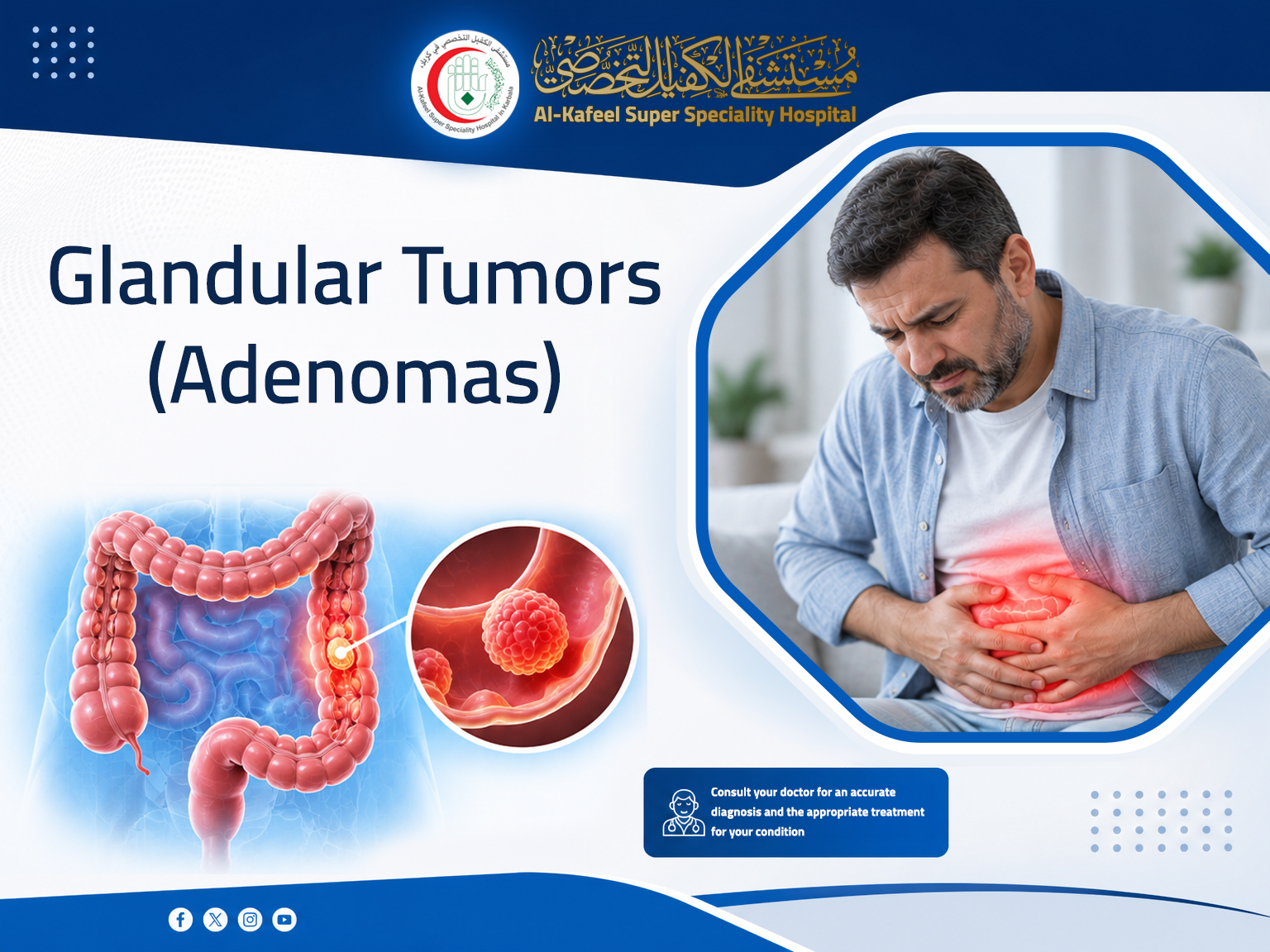
Glandular tumors appear along the stomach and colon down to the rectum, which is the last part of the colon, but they are very common in the colon in men and women generally at the age of 40 and above.
An adenoma is a benign tumor whose source is the glandular epithelium, or those that produce glandular structures.
A benign tumor is a tumor that does not pose a threat to the patient's life, as it is well-defined, does not regenerate after excision, and does not send metastases to other organs in the body.
Important Information about Glandular Tumors
Glandular tumors appear in various organs in the body, such as: the breast, the adrenals, the gallbladder, the liver, the parathyroid glands, the pituitary glands, the kidney, the salivary glands, the thyroid gland, the digestive system, the stomach, the small intestine, and the colon.
They can be single, few, or numerous, especially in the disease called familial adenomatous polyposis. It is possible for glandular tumors to be very small and delicate, not exceeding 1 or 2 millimeters, but their size may reach 5 - 6 centimeters or more, and glandular tumors may be pedunculated (with a stalk) or sessile (without a stalk).
Common Types of Glandular Tumors
There are two main types of glandular tumors, which are as follows:
Tubular adenoma: It is a relatively small-sized tumor, and mostly remains benign and does not develop into a cancerous one.
Villous adenoma: It is a larger tumor than the tubular tumor, and it mostly tends to turn into a cancerous tumor.
Factors for the Appearance of a Cancerous Tumor
Every glandular tumor in the digestive system has the potential to turn into a cancerous tumor, and this depends on several factors, the most important of which are:
The size of the glandular tumor.
Its microscopic type.
The degree of cell dysplasia, which is a term used to describe cancerous or abnormal cells.
The expected duration for the development of a cancerous tumor in a glandular tumor is 10 years, so it is important to excise all polyps found in the colon and examine them under a microscope.
Also, the condition of patients suffering from glandular tumors, or those whose family members have previously had a glandular tumor, must be monitored and tracked.
Glandular tumors may appear at a very early age in patients suffering from familial adenomatous polyposis in very large numbers, and the probability of turning into a cancerous tumor is very high.
Symptoms of Glandular Tumors
Often, no symptoms appear for a glandular tumor, which is discovered during an endoscopy, but in some cases, the following symptoms may appear:
Rectal bleeding.
Changes in bowel movement.
A change in the color of the stool.
Pain.
Anemia resulting from iron deficiency.
Causes and Risk Factors of Glandular Tumors
In truth, there are not many clear causes and factors for the formation of glandular tumors; the following is the most prominent of what has been mentioned:
1. Cause of Glandular Tumor Formation
Sometimes, cells in the body grow excessively and out of control as a result of a genetic mutation, and some abnormal cells can turn into polyps or other types of tumors. Mostly, small tubular adenomas form, which grow in a tube shape, and a less common but more dangerous type of benign tumors may also form, which are villous adenomas; instead of the cells being round or oval, they appear in an irregular cauliflower-like shape.
2. Risk Factors
The most prominent risk factors that increase the growth of glandular tumors, specifically tubular ones, include the following:
Advancing in age above 50 years.
Men are more susceptible to developing glandular tumors than women.
Obesity.
Having a family medical history of colon polyps.
Complications of Glandular Tumors
The most prominent complications of a glandular tumor include the following:
The transformation of a benign tumor into a malignant cancerous tumor.
The occurrence of cancer metastases in different places of the body, in case the tumor turns cancerous and is left without treatment.
Diagnosis of Glandular Tumors
Usually, the glandular tumor is removed from the colon, for example, completely if possible, then it is sent to a pathology laboratory to examine it. After that, a doctor specialized in pathology sends a report to the doctor responsible for the patient's condition, providing information about every sample taken.
The report shows the type of tumor the patient is suffering from, and its severity as a cancerous disease under the microscope, and dysplasia. Benign tumors that do not resemble cancer much are referred to as having low-grade dysplasia, but if the benign tumor looks more abnormal and resembles cancer, it is described as the patient suffering from high-grade dysplasia.
Treatment of Glandular Tumors
The treatment and follow-up of glandular tumors are carried out as follows:
1. Excision of Glandular Tumors
Usually, the doctor removes all the glandular tumors the patient has because they can turn into cancer. Doctors can excise a benign tubular tumor with a retractable wire loop inserted through the device used during a colonoscopy. Sometimes, small polyps can be destroyed with a special device that works via heat. If the glandular tumor is very large, the patient may need to undergo a surgical operation to remove it.
Usually, all glandular tumors must be completely removed. If the biopsy taken by the doctor to analyze the tumor type does not include the entire tumor, then the doctor must follow up with the patient again to find out what subsequent procedure awaits them.
2. Follow-up after the endoscopy procedure
The patient who has undergone an endoscopy procedure to remove glandular tumors must continue to visit the doctor periodically to ensure that glandular tumors do not form again in them.
The doctor may also advise the patient to undergo an endoscopy at specific periods as follows:
Within six months: if the tumor was large, or was removed intermittently.
Within 3 years: if there are more than 10 glandular tumors, or if the tumor size is larger than 1 centimeter, or if there are more than two tumors at least in some cases.
Within 5 - 10 years: if there was one or two small tumors during the illness.
Prevention of Glandular Tumors
The development of glandular tumors can be prevented by ensuring to undergo an endoscopies, especially for those who have a family medical history, or with advancing age above 50 years.
Colon polyps that may cause glandular tumors and their transformation into cancer can also be prevented by following these steps:
Reducing the intake of foods rich in fats, and increasing vegetables and fruits.
Ensuring the weight remains within the normal level.
Quitting smoking and drinking alcohol.
Informing the doctor in case of taking non-steroidal anti-inflammatory drugs (NSAIDs) heavily, due to increasing their risk of contributing to the formation of colon cancer.