


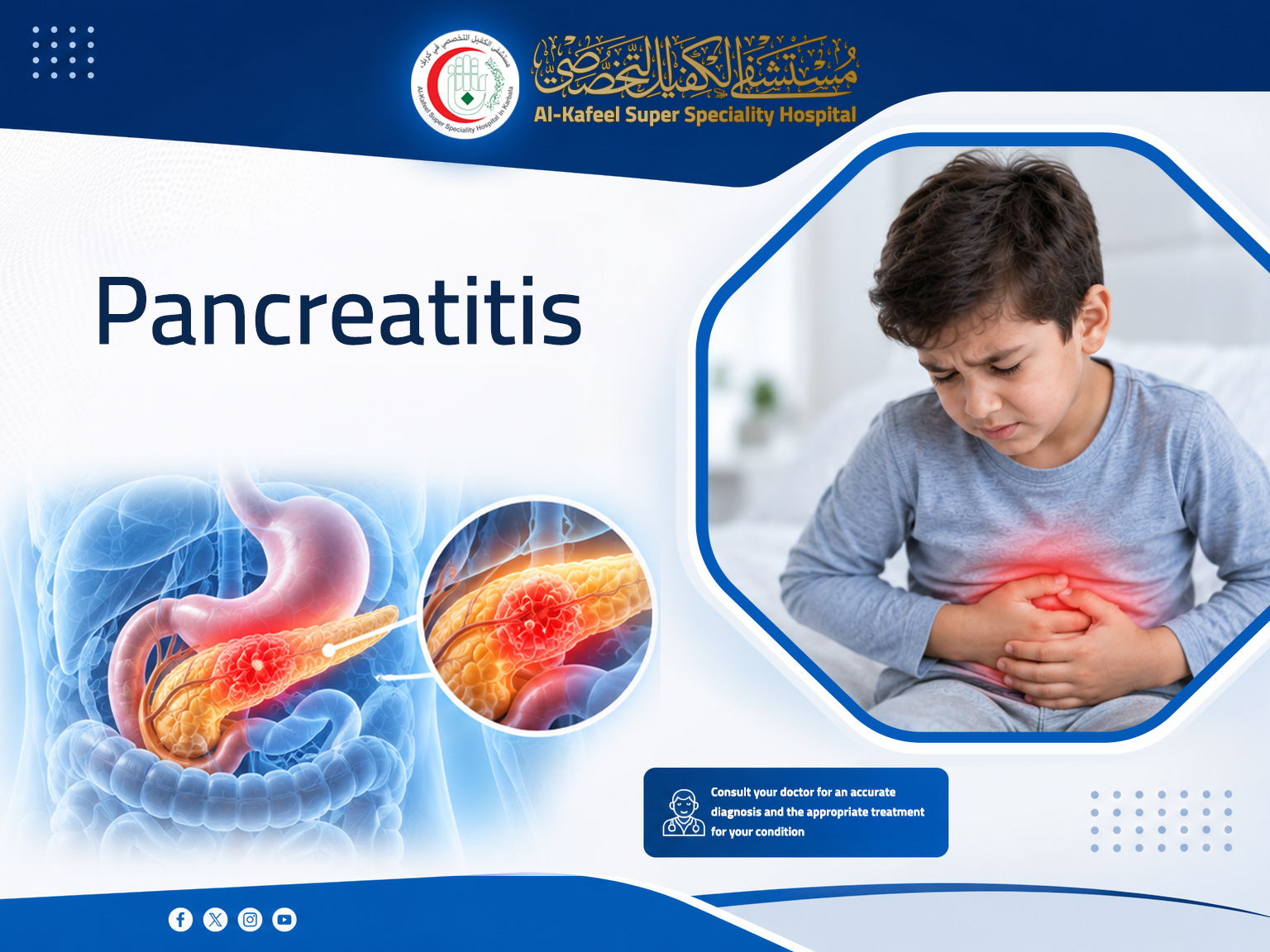
The pancreas is a gland located behind the stomach next to the duodenum, primarily functioning to:
Secrete strong digestive enzymes into the small intestine that help digest carbohydrates, proteins, and fats.
Secrete the hormones insulin and glucagon into the bloodstream, which are responsible for processing sugars in the bloodstream, and also regulate the process of storing food in the body and using it later to produce energy.
The pancreas may suffer damage resulting from the immune system attacking the pancreatic tissue, leading to inflammation in it. There are two types of pancreatitis, which are as follows:
Acute Pancreatitis
Acute pancreatitis arises and develops over a short period of time, and this is usually for several reasons, such as the following:
Formation of gallstones.
Excessive consumption of alcoholic beverages.
Taking certain types of medications.
Exposure to infections.
An imbalance in the body's metabolic processes.
Undergoing surgery.
Chronic Pancreatitis
Chronic inflammation in the pancreas often occurs after an acute inflammation of the pancreas, or as a result of continuous inflammation in it. More than 70% of chronic pancreatitis cases result from excessive consumption of alcoholic beverages over a long period of time, and it may also be due to disorders in the body's metabolic processes.
Symptoms of Pancreatitis
Symptoms that may result from pancreatitis include the following:
Severe, piercing-like pain in the upper abdomen and parts of the back, which worsens when eating fat-rich food.
Bloating and sensitivity in the abdominal cavity.
Feeling nauseous and vomiting.
Fever.
Rapid heartbeat.
Causes and Risk Factors of Pancreatitis
The causes of pancreatitis can be explained according to its type as follows:
1. Causes of Acute Pancreatitis
In most cases of acute pancreatitis, the exact cause of the condition is unknown, but causes may include the following:
Presence of gallstones.
Excessive consumption of alcoholic beverages.
Taking certain types of medications.
Imbalance in blood lipids.
Catching an infection.
Undergoing surgery.
2. Causes of Chronic Pancreatitis
These include the following:
Excessive consumption of alcoholic beverages over a long period of time.
Metabolic disorders.
A family/ genetic history of the disease.
3. Factors that increase the risk of chronic pancreatitis
There are many risk factors that may increase the risk of chronic inflammation in the pancreas, such as the following:
Excessive consumption of alcoholic beverages over a long period of time.
Gender, as men are more susceptible to chronic pancreatitis cases than women, especially those older than 35 - 40 years.
Complications of Pancreatitis
There are many complications that pancreatitis may cause, such as the following:
Infection.
Kidney failure.
Difficulty breathing.
Diabetes.
Diagnosis of Pancreatitis
Pancreatitis is diagnosed by conducting some tests, such as the following:
· Pancreatic function test.
· Glucose tolerance test.
· Ultrasound imaging.
· Computed tomography (CT) scan.
· Endoscopic retrograde cholangiopancreatography (ERCP).
· Endoscopic ultrasound.
· Treatment of Pancreatitis
The methods of treating pancreatitis according to its type will be explained below:
1. Treatment of Acute Pancreatitis
Acute pancreatitis can be treated in the hospital, as the patient is initially given medications via intravenous infusion, in addition to pain-relieving medications, and in 20% of cases, there is a need to treat the acute inflammation in the intensive care unit.
In the intensive care unit, equipment is available for close monitoring and observation of the patient during their treatment, as acute pancreatitis may cause damage to the heart, lungs, and kidneys. The acute attack of pancreatitis lasts for only a few days, and after that, the inflammation subsides, and the pancreas returns to its normal shape.
In some severe cases of acute pancreatitis, damage and death of pancreatic tissues may occur, and in this case, a surgical operation may be performed to eradicate the affected tissues, the most important information about which is below:
The surgical operation can be performed by laparoscopy, or by another minimally invasive method; when performing surgery with a laparoscope, small incisions are made in the abdominal cavity.
The laparoscope is considered one of the medical devices inserted into the abdominal cavity, and it is connected to a display screen inside the operating room; when the laparoscope is inserted into the patient's abdomen, images of the patient's internal organs are displayed on the screen, then the doctor performs the appropriate procedure.
One of the most important advantages of performing laparoscopic surgery is that opening small wounds is sufficient, which reduces the possibility of infection, and reduces pain and scars, in addition to the patient recovering faster, and in a shorter period of time.
2. Treatment of Chronic Pancreatitis
Treating this type of inflammation is more complex than treating acute inflammation, and the doctor tries to alleviate the patient's pain resulting from the inflammation. The doctor also tries to improve the disorder in the patient's metabolic processes, which may originate from the improper functioning of the pancreas, where the patient is given a set of treatments containing pancreatic enzymes and the hormone insulin if the pancreas is unable to secrete them.
Pancreatic enzymes are given in the form of tablets taken with a meal to improve the ability to absorb nutrients, and it is also usually recommended to maintain a diet containing low levels of fat. Treatment by surgery helps relieve pain in the abdominal cavity and may also reduce the frequency of pain attacks that may afflict the patient.
Patients must abstain from consuming alcoholic beverages and
follow the instructions of the doctor and the nutritionist supervising the
treatment, and patients must also be careful and persistent in taking the
necessary medications to reduce the severity of pain attacks resulting from the
inflammation.
Prevention of Pancreatitis
Excessive consumption of alcoholic beverages is considered the main cause of pancreatitis, therefore reducing them or completely abstaining from consuming them is one of the most important means of preventing the development with this type of inflammation.
Also, people who suffer from the problem of excessive consumption of alcoholic beverages can go to the treating doctor to receive the necessary instructions, and go to treatment centers for alcohol addicts.