


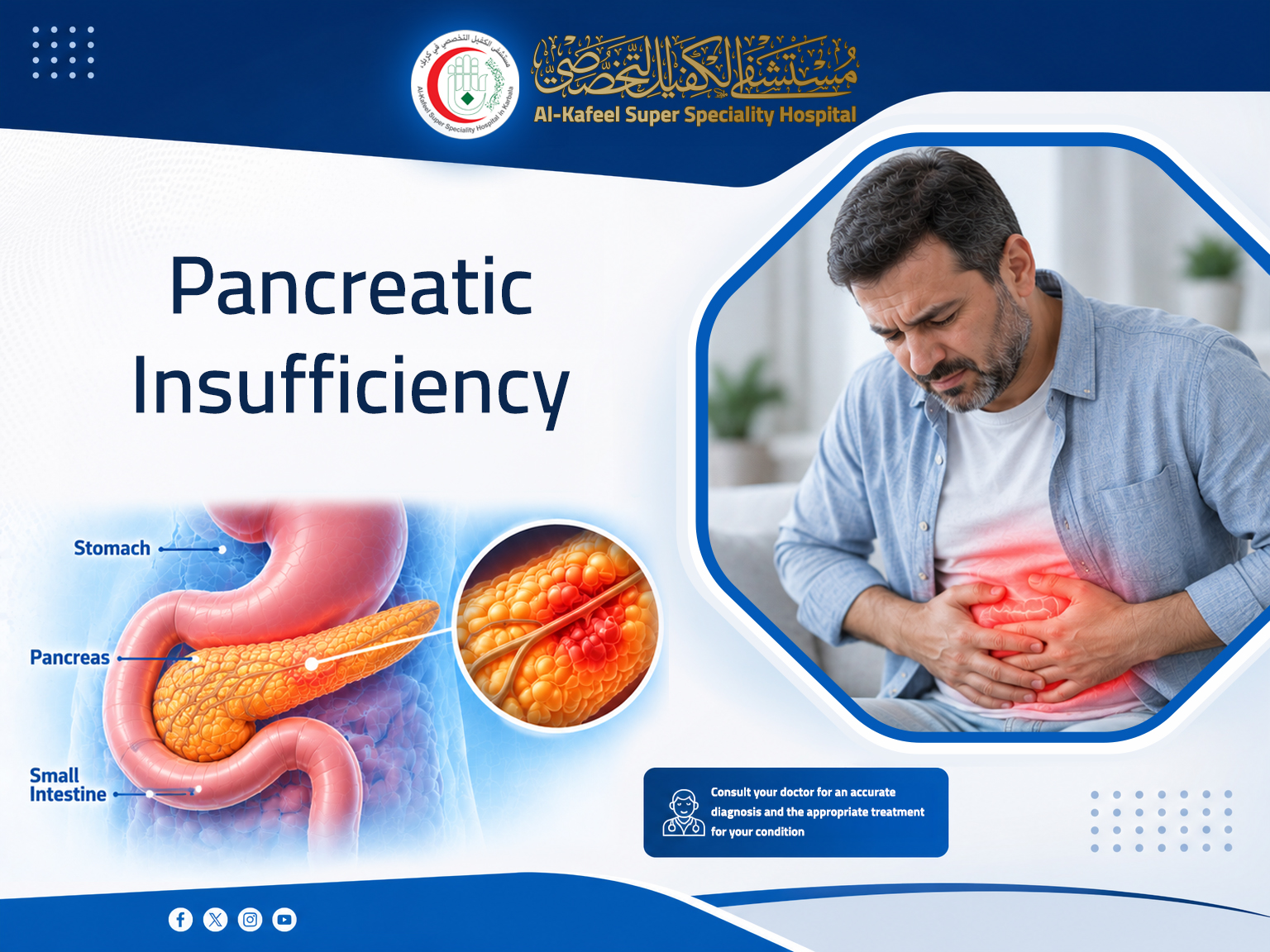
The pancreas is a thin gland located deep in the abdominal cavity, found near the stomach and below the liver; it consists of a head, a body, and a tail, and the upper part of its head is connected to the beginning of the small intestine.
The pancreas usually secretes the enzymes necessary for digestion, and it also produces some of the major hormones in the body.
Pancreatic insufficiency is a condition of pancreatic failure that occurs due to damage or a deficiency in pancreatic tissues, and if this happens, the pancreas cannot secrete or transport the enzymes responsible for digesting and breaking down food in the intestines.
Types of Pancreatic Cells and Their Functions
There are two main types of pancreatic cells, which are as follows:
1. Exocrine pancreatic cells
These cells manufacture and send digestive enzymes to digest various nutritional components, such as: fats, carbohydrates, and proteins in the small intestine; in most types, these enzymes are inactive until they reach the small intestine where they are activated. They also secrete bicarbonate to neutralize stomach acidity and activate pancreatic enzymes.
2. Endocrine pancreatic cells
This type of cell manufactures the hormones insulin and glucagon, which are hormones responsible for regulating sugar in the body.
Symptoms of Pancreatic Insufficiency
Damage to up to 90% of pancreatic tissues generally does not
lead to the appearance of clinical symptoms, and if the disease develops, the
following symptoms may appear:
Abdominal pain: Which is often related to the underlying factor and not to a deficiency in the functioning of the pancreas.
Secretion of digestive juices: As the disease progresses, signs of the pancreas's weakness in performing tasks appear in the form of external secretions, which is reflected in a disorder of nutrient absorption.
Steatorrhea (fatty diarrhea): Resulting from the non-absorption of fats.
Weight loss and deficiency in fat-soluble vitamins: Due to the non-absorption of fats.
Non-absorption of proteins and carbohydrates: Which contributes to weight loss and the appearance of signs of malnutrition, such as: general weakness, muscle atrophy, and osteoporosis.
Diabetes: As the damage progresses, the function of internal secretions is also affected, such as the secretion of hormones, especially insulin, which causes diabetes.
Causes and Risk Factors of Pancreatic Insufficiency
The most prominent causes and factors that increase the chances of developing pancreatic insufficiency include the following:
Chronic pancreatitis: Usually, the most common and primary cause of pancreatic insufficiency is chronic inflammation in the pancreas, as continuous pancreatitis causes damage to the cells responsible for secreting digestive enzymes, which hinders digestion, and ultimately causes pancreatic insufficiency.
Acute pancreatitis: Usually, short-term pancreatitis does not cause cell damage and insufficiency, but if left untreated, it may develop into chronic inflammation, which causes pancreatic insufficiency.
Autoimmune pancreatitis: If the immune system attacks the pancreas, inflammation may occur in it, causing pancreatic insufficiency.
Diabetes: Most diabetic patients face the problem of pancreatic insufficiency; in truth, scientists do not know the reason behind this, but it is believed to result from the hormonal imbalance caused by diabetes.
Pancreatic surgery: Pancreatic insufficiency is considered a common side effect of a pancreatectomy, as the disease represents 80% of cases resulting from pancreas removal.
Genetic diseases: The most prominent inherited genetic diseases include: Cystic fibrosis, which causes mucus buildup on a large number of organs, such as the lungs and the digestive system, and leads to pancreatic insufficiency. Also, Shwachman-Diamond syndrome is considered a rare syndrome that affects the patient's bones and pancreas and causes the problem of pancreatic insufficiency from a young age.
Celiac disease: It is a disease in which the patient suffers from an inability to absorb gluten. Although some follow a diet and stay away from gluten, a portion of them still suffer from diarrhea, and it is believed that the reason is the presence of a pancreatic insufficiency problem alongside celiac disease.
Pancreatic cancer: Pancreatic insufficiency is considered one of the side effects resulting from pancreatic cancer.
Inflammatory bowel disease (IBD): The most prominent of these are ulcerative colitis and Crohn's disease.
Complications of Pancreatic Insufficiency
The most prominent complications of pancreatic insufficiency include:
Osteoporosis resulting from malnutrition.
Anemia resulting from malnutrition.
Developing diabetes.
Diagnosis of Pancreatic Insufficiency
The disease is diagnosed by following the below:
1. Physical examination
The doctor asks the patient to describe their condition, the pains that afflict them and their initial location, and the most important symptoms; the doctor also asks about the smell of the stool.
2. Stool test
The patient is asked to perform a stool test for three consecutive days to determine the amount of fat present in the stool. Usually, different containers are used to collect stool in this case.
3. Imaging tests
The most prominent imaging tests include the following:
X-ray imaging.
Computed Tomography (CT) scan.
Ultrasound imaging.
Calcification usually appears inside the pancreas with the disappearance of healthy pancreatic tissues, or the presence of inflammation in them. Sometimes it is difficult for signs of pancreatic damage to appear in routine imaging tests, and therefore there is a need to use advanced imaging tests, or internal tests, such as:
Endoscopic Ultrasound (EUS).
Endoscopic Retrograde Cholangiopancreatography (ERCP).
Treatment of Pancreatic Insufficiency
The treatment of pancreatic insufficiency includes several stages:
1. Treating the primary disease causing the damage
This is done through:
· Primarily treating pancreatitis if it is present.
· Quitting drinking alcohol.
· Anti-pain treatment using pain relievers.
2. Treating absorption disorder
This is done by giving pancreatic enzymes orally; today, there are many medications available that contain the majority of pancreatic enzymes necessary for digestion and absorption, such as: pancrease. These medications are taken with meals to allow the proper absorption of most nutrients in an almost natural and healthy manner. Malabsorption can be alleviated by giving fats with short-chain fatty acids and adding vitamins.
3. Treating the complications of the disease
Malnutrition is treated by giving the patient the necessary vitamins and elements, such as:
· Vitamin A.
· Vitamin K.
· Vitamin D.
· Vitamin E.
· Vitamin C.
· Zinc.
· Calcium.
As for the treatment of diabetes, it is done through familiar methods by following a diet, and taking medication to treat high blood sugar, which may be oral, or through insulin.
Prevention of Pancreatic Insufficiency
In a number of cases resulting from some genetic diseases, such as cystic fibrosis, or those incurable diseases, such as diabetes, or pancreatic cancer, the onset of pancreatic insufficiency cannot be prevented.
However, in some cases, we may find ways to prevent the disease, such as:
Reducing alcohol consumption.
Quitting smoking.
Reducing the intake of fatty foods.