


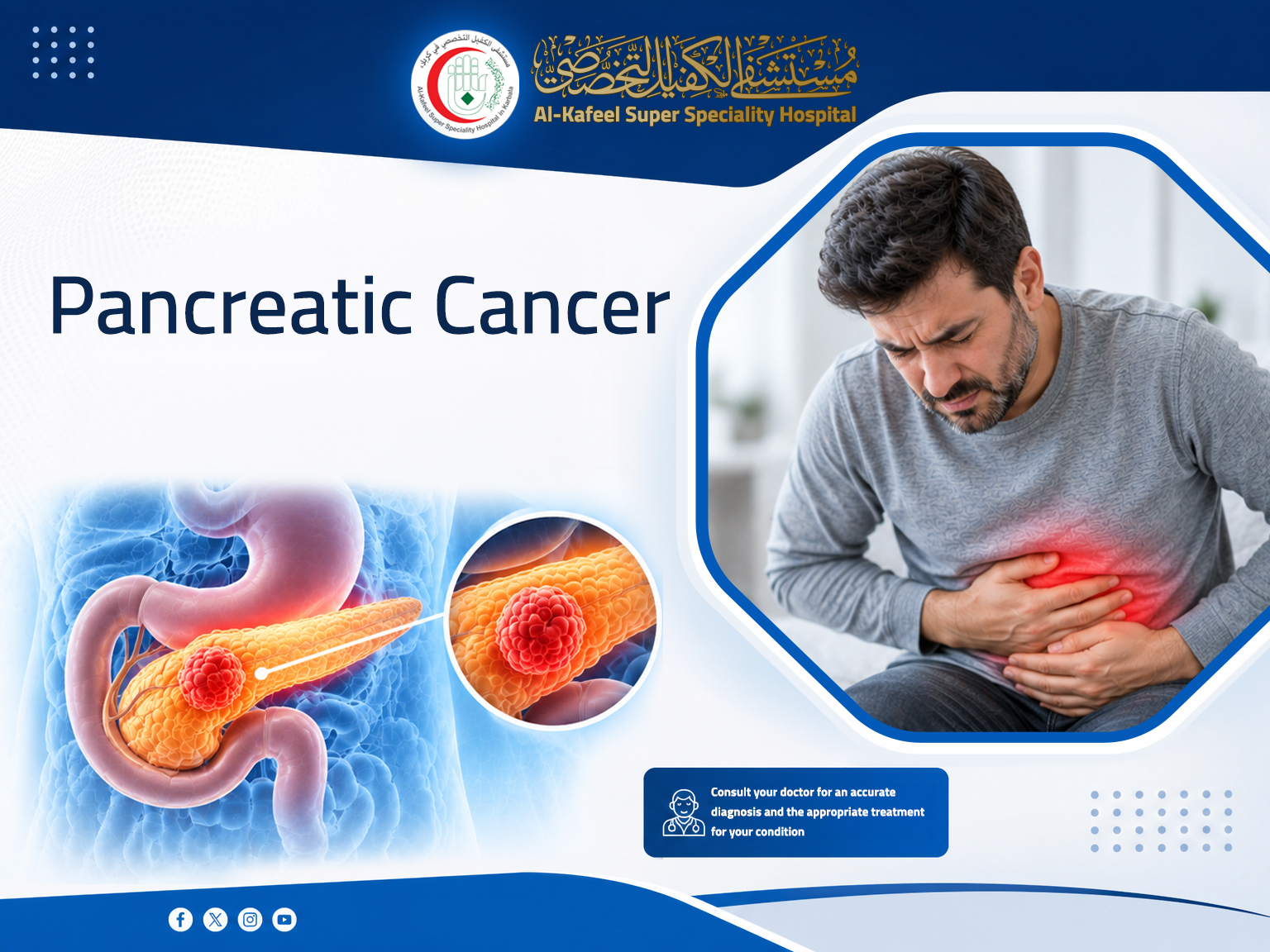
The pancreas is a large internal organ located horizontally in the lower back part of the abdominal cavity. The pancreas secretes enzymes that help in digestion processes, and hormones that help regulate the metabolism of sugars and carbohydrates in the body.
The size of the pancreas is 15 centimeters, and it looks like a pear lying on its side. The pancreas is a central organ in the digestive system, as it secretes hormones including insulin, and also produces digestive acids that help the body in food digestion processes.
Pancreatic cancer begins to form in the tissues of the pancreas.
The chances of recovering from pancreatic cancer are very small, even if pancreatic cancer is diagnosed at a very early stage. It tends to spread very rapidly and is not discovered in its early stages except in very rare cases, and this is the main reason why this cancer causes the highest percentage of deaths resulting from cancerous diseases. Mostly, symptoms of pancreatic cancer do not appear until after the cancer has reached a relatively advanced stage, and it is no longer possible to remove the tumor through surgery.
Types of Pancreatic Cancer
The types of cells that have a role in the formation of pancreatic cancer help determine the most appropriate and effective treatment, and the types of pancreatic cancer include:
1. Cancer originating in the pancreatic ducts (Adenocarcinoma)
It is a cancer that forms in the cells lining the pancreatic ducts which help produce digestive acids, and the majority of pancreatic cancer cases are of this adenocarcinoma type, which is sometimes called exocrine tumors.
2. Cancer originating in hormone-producing cell
It is a cancer that forms in the cells that produce hormones inside the pancreas, and it is also called endocrine tumors, and tumors of this type are very rare.
Degrees of Severity of Pancreatic Cance
The stages of pancreatic cancer can be determined in several ways.
1. Stages of pancreatic cancer according to resectability
The severity stages of pancreatic cancer can be defined in different ways; one of these ways is staging according to the following:
Resectable: It is possible to remove all the small cancerous masses.
Locally advanced: It is no longer possible to remove the cancer through surgery at this stage, due to its spread into tissues surrounding the pancreas.
Metastatic: At this stage, the cancer has moved to distant organs, such as the liver or the lungs.
2. Stages of pancreatic cancer by Roman numerals
Another method of definition is by using Roman numerals:
Stage I: The cancer is confined within the pancreas only.
Stage II: The cancer has spread outside the pancreas into tissues adjacent to the pancreas, and it is possible that it has reached the lymph nodes.
Stage III: The cancer has spread outside the pancreas into vital blood vessels adjacent to the pancreas, and it is possible that it has reached the lymph nodes as well.
Stage IV: The cancer has spread and reached organs distant from the pancreas, such as the liver or lungs, and to the inner lining of the abdominal cavity.
Symptoms of Pancreatic Cancer
Symptoms of pancreatic cancer mostly do not appear until after the pancreatic cancer has reached a relatively advanced stage. When symptoms begin to appear, they may include:
· Pains in the upper abdomen radiating to the back.
· Loss of appetite.
· Weight loss.
· Depression.
· Causes and Risk Factors of Pancreatic Cancer
· There are many factors and causes that lead to pancreatic cancer.
· Cause of Pancreatic Cancer
Pancreatic cancer forms when cells in the pancreas develop genetic mutations. These mutations lead to the cells multiplying in an unmonitored and uncontrolled manner, and to extending their lifespan much longer than the lifespan of normal cells; when these cells accumulate, they may form a tumor.
Risk Factors
Factors that may increase the risk of developing pancreatic cancer include:
· Smoking.
· Obesity.
· A family history of pancreatitis.
· A family history of pancreatic cancer.
A family history of suffering from different syndromes that may increase the risk of developing pancreatic cancer, such as:
The genetic mutation called BRCA2.
Peutz-Jeghers syndrome.
Lynch syndrome.
Familial tendency to develop atypical tumors of the Familial Atypical Multiple Mole Melanoma (FAMMM) type.
Advancing age; most people diagnosed with pancreatic cancer are 70 - 80 years old.
Complications of Pancreatic Cancer
The more advanced the stage of pancreatic cancer, the more capable it is of causing more potential complications, and these can include:
· Pains.
· Jaundice.
· Bowel obstruction.
· Weight loss.
· Death.
Diagnosis of Pancreatic Cancer
Researchers are trying to find ways to ensure the early detection of pancreatic cancer, but there is no agreement on which people are recommended to undergo various screening tests, nor on what are the most reliable screening tests for the early detection of pancreatic cancer when it is still in its infancy, and reliable routine tests for the early detection of pancreatic cancer are not yet available.
Diagnosis of Pancreatic Cancer
When a doctor suspects that a patient is suffering from pancreatic cancer, one or more of the following tests are performed to reach a final diagnosis:
· Ultrasound imaging.
· Computed Tomography (CT) scan.
· Magnetic Resonance Imaging (MRI).
· Endoscopic Retrograde Cholangiopancreatography (ERCP).
· Endoscopic Ultrasound (EUS).
· Biopsy.
· Determining the Stage of Pancreatic Cancer
After confirming the diagnosis, the extent of the cancer's spread and its degree of severity must be determined, as staging the cancer's severity helps determine treatment possibilities. In order to determine the severity stage of pancreatic cancer, the following tests must be performed:
· Laparoscopy.
· Chest X-ray.
· Computed Tomography (CT) scan.
· Magnetic Resonance Imaging (MRI).
· Positron Emission Tomography (PET) scan.
· Bone scintigraphy (Bone scan).
· Blood tests.
· Treatment of Pancreatic Cancer
The treatment of pancreatic cancer depends on the stage it has reached and its location, and it also depends on the patient's age, their general health condition, and the treatment methods they personally prefer. The primary goal of treatment is to eliminate the cancer if possible.
However, if this possibility is unlikely and it is not possible to achieve this goal, then the focus should be on preventing the spread of cancer from the pancreas to other organs and preventing additional damage. When pancreatic cancer has reached a very advanced stage, there is likely to be no benefit from treatment; in such a case, the doctor recommends adopting treatments aimed at alleviating the severity of the symptoms the patient suffers from and providing them with a greater degree of comfort.
Most Prominent Treatment Methods for Pancreatic Cancer
Here are the most prominent treatment methods for pancreatic cancer:
1. Surgery
A very small portion of cancerous tumors in the pancreas are considered resectable, meaning there is serious hope of removing them completely through surgery. If the cancer has spread outside the pancreas and invaded other organs in the body, such as lymph nodes or blood vessels, surgical operations cannot be adopted as a treatment possibility.
When performing surgery is possible, the oncologist may recommend the following:
Performing a surgical operation to remove tumors in the head of the pancreas.
Performing a surgical operation to remove tumors in the body of the pancreas, or in its tail.
Research has proven that surgery to remove pancreatic cancer causes very few complications if performed by specialists in the field.
2. Other Treatment Methods
Here are the most important methods used to treat pancreatic cancer:
· Radiation therapies.
· Chemotherapies.
· Targeted drug therapy.
· Modern Treatment Methods
· Modern therapeutic methods that are recently being researched and tested include:
· Medications that prevent the cancerous tumor from producing new blood vessels.
· Vaccines against pancreatic cancer.
Clinical Trial
Clinical trials are research aimed at examining new types and new methods of treatment, such as: new medications, new surgical methods, radiation therapies of a new type, and new fields, such as gene therapy. If the effectiveness of modern treatment methods, or the safety of their use compared to existing treatments, is proven, then they become accepted treatment methods.
Clinical trials cannot guarantee a cure, and they may be accompanied by previously unexpected complications and side effects. On the other hand, clinical trials related to cancer are conducted under strict supervision to ensure they are conducted at maximum safety levels, and moreover, clinical trials may provide an opportunity to benefit from modern treatment methods that could not be accessed otherwise.
Prevention of Pancreatic Cancer
Despite the absence of a specific proven method to prevent pancreatic cancer, it is possible to follow the risk of developing the disease:
Stop smoking.
Maintain a healthy weight.
Engage in physical activity consistently.
Maintain a healthy and balanced diet.
Alternative Treatments
A patient may resort to trying any available treatment in an attempt to recover from the disease. In this context, the majority of patients resort to complementary medicine, and to a variety of diverse treatments offered by alternative medicine, especially when the chances of recovery with traditional medicine treatments are very slim, but the availability of any complementary or alternative curative treatment for pancreatic cancer has not been proven.
However, alternative or complementary treatments can alleviate the symptoms accompanying pancreatic cancer and the severity and difficulty of the treatments that must be undergone to treat pancreatic cancer, and in all cases, it is preferable to consult the treating doctor regarding the available treatment possibilities. Complementary or alternative treatments that can be useful and helpful include:
Acupuncture.
Massage.
Meditation.